

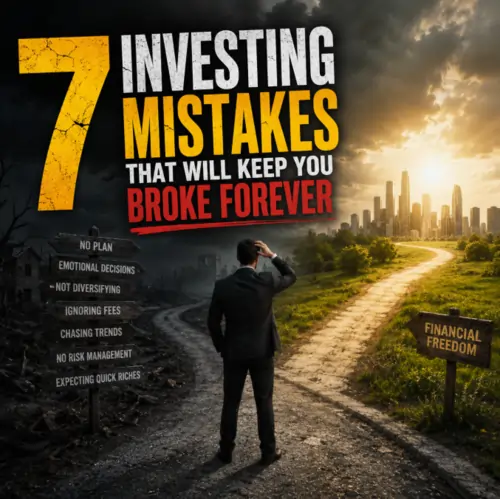
Investing mistakes that will keep you broke include trying to time the market, paying excessive fees, failing to diversify, and letting emotions drive decisions. Common investing errors that destroy wealth often go unnoticed until it’s too late. Worst investment mistakes to avoid for financial freedom involve speculating instead of investing, chasing hot tips, and neglecting emergency funds.
How to avoid investing mistakes that keep you poor starts with understanding these seven wealth‑killing traps. Top investing pitfalls that prevent wealth building are predictable—and avoidable—once you know what to look for.
Introduction: The Silent Wealth Killers
Most people don’t lose their savings in a single catastrophic event. They lose it slowly, quietly, through a series of investing mistakes that will keep you broke—small errors repeated year after year until the damage becomes irreversible.
Financial expert Ramit Sethi puts it bluntly: “Do you even understand how you are being preyed upon? Think about a deer in the forest: They’re always looking around, on alert because they know they’re in danger. But with investing, people have no idea how they are being taken advantage of.”
The truth is, the path to financial freedom is littered with well‑intentioned decisions that backfire. You don’t need to make one massive blunder to stay broke. You just need to make the same small mistakes repeatedly.
This article exposes the seven most dangerous investing mistakes that will keep you broke—and, more importantly, shows you exactly how to avoid each one. Whether you’re a complete beginner or a seasoned investor, you’ve likely fallen into at least one of these traps.
Mistake #1: Trying to Time the Market
If there is one investing mistake that will keep you broke faster than any other, it’s trying to time the market. The logic seems sound: buy low, sell high. But in practice, it’s a guaranteed path to underperformance.
Ramit Sethi demonstrates this with a powerful example: if you invested $10,000 and kept it in the market for 15 years, you’d end up with about $30,700. But if you missed just the best 30 investing days during that period, you’d have only $6,873. You’d actually lose money.
“You think you can control when to invest. Is it high? Is it low? Oh, the newspaper says it’s really dangerous, I better pull my money out,” Sethi warns. “If you were trying to control your investments and invest when the market was low, and if you were trying to sell when the market was high, you would have likely lost hundreds of thousands of dollars over the course of your lifetime.”
The irony? Investing mistakes that will keep you broke often come from a desire for more control. But as Sethi explains, “In investing, you actually want less control.”
Fidelity echoes this warning: many investors “avoid investment decisions due to uncertainty,” waiting for a “perfect moment” to jump in. But there is no perfect moment. When your cash sits idle earning next‑to‑nothing, you’re losing purchasing power to inflation.
The fix: Stop trying to predict the market. Use dollar‑cost averaging—investing fixed amounts on a regular schedule, no matter what the market is doing. This forces you to stay in the game and removes emotion from the equation.
Mistake #2: Paying Excessive Fees
You might not notice a 1% fee here or a 2% charge there. But over decades, investing mistakes that will keep you broke often hide in plain sight—inside the fine print of your investment statements.
Alan Donegan, who retired at 40 and now teaches financial independence, offers a sobering example: “Even a 1% fee paid to a professional can add up to hundreds of thousands of dollars, which means delaying your financial independence.”
His wife Katie learned this the hard way. She originally invested with a very high‑fee advisor. “We worked it out later and realized that if we hadn’t switched to low‑cost index funds, we would be over a million British pounds worse off.”
Ramit Sethi is equally critical of percentage‑based advisor fees, calling them one of the biggest investing mistakes that will keep you broke. The problem is simple: “The more you pay in fees, the less you keep.”
The fix: Pay attention to expense ratios, management fees, and advisory costs. Switch to low‑cost index funds or ETFs whenever possible. If you work with an advisor, prefer flat‑fee or hourly arrangements over percentage‑based models.
Mistake #3: Failing to Diversify
Putting all your eggs in one basket is one of the oldest investing mistakes that will keep you broke—yet it remains astonishingly common.
Beginners often pile into a single stock, a single sector, or even a single country. Devina Mehra, a seasoned market expert, warns against having “90‑100% of assets in India” (or any single country). She calls this “single country single currency single asset (SCCAR) risk.”
“In any long‑term financial planning for goals decades hence, do not be stuck with single country single currency single asset risk.”
The Motley Fool echoes this: “Diversify your portfolio to mitigate risks.” Yet many investors ignore this basic principle, either out of overconfidence or simple laziness.
The fix: Spread your investments across different asset classes (stocks, bonds, real estate), different sectors, and different geographic regions. A well‑diversified portfolio reduces risk without sacrificing returns.
Mistake #4: Letting Emotions Drive Your Decisions
Investing mistakes that will keep you broke are almost always emotional. Fear, greed, overconfidence, and panic are the real enemies of wealth.
UBS explains that “people who make emotional decisions when investing often miss out on opportunities for returns.” Investors buy after prices have already risen (driven by FOMO) and sell during crises (driven by fear)—exactly the opposite of what they should do.
“Overconfidence usually leads to taking more risk, which in turn leads to being guided by your emotions.”
One of the most dangerous emotional traps is overestimating your abilities as an investor. People like to attribute successes to their own abilities and blame external circumstances for failures. This leads to excessive faith in investments and larger, riskier bets.
Another is developing an emotional attachment to investments. You hold onto a losing stock because you like the company, ignoring the potential for loss and missing out on better opportunities.
Bankrate advises: “Turn off the TV and check your accounts on a less frequent cycle, like once per month.” The less you watch, the fewer emotional decisions you’ll make.
The fix: Create a written investment plan during calm periods. Stick to it regardless of market noise. Automate your contributions. And remember: time in the market beats timing the market.
Mistake #5: Speculating Instead of Investing
This is one of the most misunderstood investing mistakes that will keep you broke. Many people confuse speculation with investing—and the difference is everything.
Alan Donegan draws a clear line: “Investing is buying an asset that creates a return, such as a rental property or a stock from a business that is trading. Speculation is buying something with the hopes that you can sell it for more later.”
He points to trends like buying whiskey or Lego as investments: “They just pray that prices go up but some of these items cost money to store and look after. So it really is a gamble.”
“If you buy Apple stock, there are thousands of employees, stores everywhere, and people buying and producing the phones. You’ve got a trading business, whereas whiskey does nothing.”
Devina Mehra warns against “using stock market investments for entertainment”—treating investing like a casino rather than a serious wealth‑building activity.
The fix: Before you buy anything, ask yourself: Does this asset produce value, or am I just hoping someone else will pay more for it later? Stick to productive assets—stocks of profitable companies, bonds, real estate that generates income.
Mistake #6: Chasing Hot Tips and the “Next Big Thing”
Investing mistakes that will keep you broke often begin with a whisper: “I heard this stock is going to explode.”
The Motley Fool calls this “buying on someone else’s convictions” and describes it as “honestly the worst investing mistake you can make.” People have all kinds of opinions on investments, and “most of them aren’t remotely qualified to utter them out loud.”
Devina Mehra lists “chasing tips and market bubbles” as one of the cardinal errors that erode wealth. Ramit Sethi warns against “jumping on the next big thing”—the latest fad that promises unrealistic returns.
Fidelity adds that “chasing unrealistic returns” is a common trap. If something sounds too good to be true, it almost always is.
The fix: Never invest in anything you don’t understand. Before buying, research the company, its financials, its competitive position, and its long‑term prospects. If you can’t explain why you’re buying it in simple terms, don’t buy it.
Mistake #7: Neglecting Your Emergency Fund
The final investing mistake that will keep you broke happens before you even start investing.
Too many people pour every spare peso into stocks, crypto, or speculative ventures—leaving themselves with zero safety net. Then, when an emergency strikes (job loss, medical crisis, car repair), they’re forced to sell their investments at the worst possible time.
“Investing should be done with money that isn’t needed for anything else, like expenses and [obligations].”
Having no emergency fund is a wealth‑destroying mistake. It forces you to become a distressed seller—exiting positions during market downturns precisely when you should be buying.
The fix: Before you invest a single peso, build an emergency fund covering 3 to 6 months of essential expenses. Keep it in a high‑yield savings account or money market fund—somewhere safe and accessible. Only then should you start investing.
How to Avoid These Investing Mistakes That Will Keep You Broke
Avoiding these investing mistakes that will keep you broke doesn’t require a finance degree. It requires discipline, patience, and a willingness to learn.
Here are five practical steps to protect yourself:
- Create a written investment plan. Define your goals, time horizon, and risk tolerance. Review it annually—but don’t change it based on daily market noise.
- Automate your investments. Set up automatic contributions to low‑cost index funds or ETFs every payday. This removes emotion and enforces discipline.
- Diversify broadly. Spread your money across different asset classes, sectors, and countries. Don’t put all your eggs in one basket.
- Keep costs low. Pay attention to fees. Over decades, even small differences compound into massive sums.
- Stay the course. Markets will crash. They will also recover. The worst thing you can do is panic and sell at the bottom.
Frequently Asked Questions
1. What is the biggest investing mistake that will keep you broke?
Trying to time the market is arguably the most destructive investing mistake that will keep you broke. Missing just a few of the market’s best days can turn gains into losses over a 15‑year period.
2. Why do most beginner investors lose money?
Most beginners lose money because they make emotional decisions, chase hot tips, fail to diversify, and try to time the market.
3. How can I avoid common investing mistakes?
Create a written plan, automate your investments, diversify broadly, keep costs low, and stay the course during market volatility.
4. Is it better to invest all at once or gradually?
Gradual investing (dollar‑cost averaging) is generally safer and removes the emotional pressure of trying to time the market.
5. What are the signs of a pyramid scheme?
If an investment promises guaranteed high returns with little risk, relies on recruiting new members, and has no clear product or service, it’s likely a pyramid scheme. Learn more here.
6. How do I protect my investments from scams?
Research every investment thoroughly, avoid pressure tactics, verify credentials, and never invest in anything you don’t understand. Read our full guide.
7. What is the best way to start investing with little money?
Start with a low‑cost index fund or ETF. Many platforms allow you to start with as little as ₱1,000. The key is to start early and be consistent.
8. How much should I keep in an emergency fund before investing?
Aim for 3 to 6 months of essential expenses in a safe, accessible account before you start investing.
9. What are dividend stocks and are they a good investment?
Dividend stocks pay you a share of the company’s profits regularly. They can be a great source of passive income if chosen wisely. Discover the secrets of profitable dividends.
10. Should I invest my emergency fund?
No. Your emergency fund should be kept in safe, liquid accounts—not exposed to market risk.
11. What is dollar‑cost averaging?
Dollar‑cost averaging means investing a fixed amount of money at regular intervals, regardless of the asset’s price. This reduces the impact of volatility.
12. Why do financial advisors charge percentage fees?
Percentage‑based fees are common but can be costly over time. Consider flat‑fee or hourly advisors instead.
13. What is the difference between investing and speculating?
Investing buys productive assets that generate returns. Speculation buys assets hoping someone else will pay more later.
14. How do I know if I’m overconfident as an investor?
If you attribute your wins to skill and your losses to bad luck, you may be overconfident. This leads to taking excessive risks.
15. Can I invest my emergency fund in passive income ideas?
No. Your emergency fund should remain safe and liquid. However, once your emergency fund is secure, explore these profitable passive income ideas.
16. What should I do during a market crash?
Stay calm. Stick to your plan. If you have cash available, consider buying more—but only if your emergency fund is intact.
17. Why do people sell during market downturns?
Fear and panic drive selling. The media amplifies this with alarming headlines. Turn off the news and stick to your long‑term plan.
18. How often should I check my investments?
Once a month is sufficient. Checking daily leads to emotional decisions.
19. What is the safest way to invest?
No investment is completely safe, but broadly diversified index funds and government bonds are among the lower‑risk options.
20. Where can I learn more about smart investing?
Start with our complete guide: 7 Investing Mistakes That Will Keep You Broke.
Conclusion: The Path to Financial Freedom
Investing mistakes that will keep you broke are not inevitable. They are choices—often unconscious ones—that you can learn to recognize and avoid.
The seven traps we’ve covered—market timing, excessive fees, lack of diversification, emotional decisions, speculation, chasing hot tips, and neglecting your emergency fund—are the most common reasons people never build lasting wealth.
But here’s the good news: avoiding these mistakes is simpler than you think. You don’t need to be a financial genius. You don’t need to beat the market. You just need to:
- Start early and stay consistent
- Keep costs low and diversify broadly
- Control your emotions and stick to your plan
- Build a safety net before you invest
- Never invest in what you don’t understand
As the Donegans remind us: “Time in the market is better than timing the market.” The investors who win aren’t the ones who make the most brilliant predictions. They’re the ones who stay invested through the ups and downs, letting compound interest do its magic.
Your financial future is in your hands. Avoid these investing mistakes that will keep you broke—and start building the wealth you deserve.
For more insights on protecting your wealth, read our guides on signs you are in a pyramid scheme, how to protect your investments from all scams, secrets of profitable dividends, ways to invest your emergency fund, and profitable passive income ideas.