


Mistakes Small Business Owners Often Make Key Takeaways
Every year, thousands of entrepreneurs learn the hard way that tax mistakes cost more than just money.
- Mistakes Small Business Owners Often Make include co-mingling finances, missing deductions, and filing late, which together cost thousands in penalties every year.
- Simple systems like weekly bookkeeping reviews and digital receipt storage prevent the majority of common small business tax filing errors .
- Proactive tax planning tips for entrepreneurs and startups can reduce your tax burden by 20–30% while keeping you compliant.
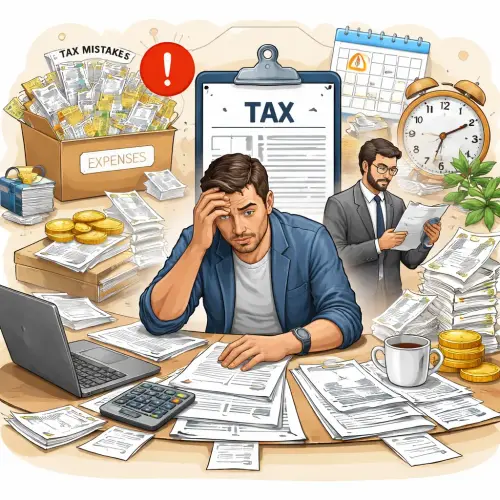
Why Understanding These Mistakes Small Business Owners Often Make Is Critical for Your Bottom Line
Every year, thousands of entrepreneurs learn the hard way that tax mistakes cost more than just money. They cost time, energy, and sleepless nights. The Mistakes Small Business Owners Often Make are predictable and avoidable when you know what to look for. This guide takes you through the ten most common pitfalls and shows you exactly how to steer clear of them.
Whether you’re a freelancer selling digital products, a startup founder with a handful of employees, or an ecommerce seller juggling multiple sales tax jurisdictions, the principles are the same. Let’s fix your tax process before the IRS comes knocking.
1. Mixing Personal and Business Expenses Tax Problems
Perhaps the single most common mistake is using one bank account for everything. When you pay for a business subscription from your personal card or grab lunch with a client using your business debit card without separating the transaction, you create a nightmare for yourself. Mixing personal and business expenses tax problems arise because the IRS scrutinizes businesses that blur these lines.
Why This Creates Audit Risk
If your business tax return shows personal expenses, an auditor may disallow legitimate deductions. Even worse, they may flag your entire return for review. The solution is simple: open a dedicated business bank account and a business credit card. Use them exclusively for business transactions.
How to Fix It
Go back through the last three months. Highlight every transaction that was personal but ran through your business account. Reimburse the business from your personal funds and categorize the expense correctly going forward. Then set up a recurring weekly task to reconcile your accounts.
2. Common Small Business Tax Filing Errors: Late Filing and Missed Deadlines
Common small business tax filing errors aren’t always about math. Sometimes they are about the calendar. Filing even one day late can trigger penalties. The IRS charges a failure-to-file penalty of 5% per month up to 25% of the unpaid tax. For a business that owes $10,000, that’s $500 every 30 days. For a related guide, see 15 Common Tax Mistakes That Could Cost You Thousands.
Understanding Late Tax Filing Consequences for Small Businesses
Late tax filing consequences for small businesses extend beyond the penalty. You also lose your ability to claim certain credits or deductions that expire with the filing deadline. Interest compounds daily on any unpaid balance, so a small delay can grow into a significant debt.
Your Deadline Checklist
Mark these dates on your calendar right now: March 15 for S-corps and partnerships, April 15 for sole proprietors and single-member LLCs, and quarterly estimated tax deadlines on April 15, June 15, September 15, and January 15. Consider filing an extension if you need more time, but remember that an extension to file is not an extension to pay.
3. Missing Business Tax Deductions Small Owners Overlook
Every year, small business owners leave hundreds or thousands of dollars on the table by not claiming every deduction they qualify for. The missing business tax deductions small owners overlook category includes home office expenses, vehicle mileage, software subscriptions, professional development courses, and even a portion of your internet and phone bills. For a related guide, see 8 Tax Planning Strategies for Small Businesses.
Deductions You Are Probably Forgetting
Here are some commonly missed deductions:
- Home office deduction (regular and exclusive use space)
- Business mileage at the standard IRS rate
- Health insurance premiums for self-employed individuals
- Retirement plan contributions (SEP IRA or Solo 401k)
- Education and training directly related to your business
Use a dedicated bookkeeping tool like QuickBooks or Xero to track every category. Review your expenses quarterly to ensure you’re not missing anything.
4. Payroll Tax Mistakes Small Businesses Make
If you have employees, you carry a huge responsibility. Payroll tax mistakes small businesses make include misclassifying workers, failing to deposit withheld taxes on time, and not filing Form 941 quarterly. The IRS is particularly aggressive about payroll taxes because these funds represent the employee’s share of Social Security and Medicare taxes. For a related guide, see 8 Smart Ways to Organize Your Tax Documents.
The Trust Fund Recovery Penalty
If you withhold taxes from employee paychecks but don’t remit them to the IRS, you can be held personally liable for the Trust Fund Recovery Penalty. That means the IRS can seize personal assets, bank accounts, and even garnish your wages. Always use a reliable payroll service like Gusto or ADP to ensure your deposits are made automatically.
Best Practices for Payroll Compliance
Run payroll at least twice a month. Reconcile your payroll tax accounts every quarter. Keep a separate bank account for payroll taxes so you never accidentally spend that money on operating expenses.
5. Estimated Tax Payment Mistakes Entrepreneurs Make
Many new business owners think they only pay taxes once a year. That is a costly assumption. The IRS requires you to pay estimated taxes quarterly if you expect to owe $1,000 or more. The estimated tax payment mistakes entrepreneurs make often involve paying too little or forgetting to pay entirely.
How to Calculate Estimated Payments
Estimate your annual income, subtract your deductions and credits, then divide by four. Any payment that falls short of 90% of the current year’s tax liability or 100% of the previous year’s tax liability triggers an underpayment penalty. Use IRS Form 1040-ES to guide your calculations.
Avoiding the Penalty
Set up automatic monthly transfers to a savings account designated for taxes. Then, when the quarterly due date arrives, you already have the money ready. This simple habit prevents estimated tax payment mistakes entrepreneurs make from becoming a recurring problem.
6. Bookkeeping Mistakes That Affect Business Taxes
Taxes don’t start at the end of the year. They start the moment you earn your first dollar. Bookkeeping mistakes that affect business taxes include failing to categorize transactions properly, missing receipts, and not reconciling bank statements monthly. When tax time arrives, these errors create confusion, missed deductions, and inaccurate returns.
Daily vs. Monthly Bookkeeping
Ideally, you review your books weekly. At minimum, reconcile your accounts each month. A 15-minute weekly review catches errors while they are still fresh in your mind. It also gives you a real-time view of your business’s financial health.
Tools to Simplify Bookkeeping
Consider using FreshBooks, Wave (free for basic features), or QuickBooks Self-Employed if you are a freelancer. These tools sync with your bank accounts, categorize transactions automatically, and generate reports that are ready for your CPA.
7. How to Organize Receipts and Records for Taxes
Paper receipts are the enemy of organized tax preparation. They fade, get lost, and take up space. The real question is how to organize receipts and records for taxes efficiently so you never lose a deduction again.
Digital Receipt Storage Systems
Use a scanning app like Expensify, Receipt Bank (now Dext), or even Google Drive with proper folder naming. Take a photo of each receipt immediately after a purchase. Tag it with the vendor name, date, amount, and business category. Store everything in folders organized by month and year.
Record Retention Rules
The IRS generally recommends keeping records for three years after you file, but you should keep payroll records for four years and any property-related records (like equipment purchases) for as long as you own the asset plus seven years after you dispose of it.
8. Mistakes When Hiring Contractors Versus Employees for Taxes
It is tempting to classify all workers as independent contractors to avoid payroll taxes and benefits. However, mistakes when hiring contractors versus employees for taxes can result in massive back taxes, penalties, and even lawsuits. The IRS uses a 20-factor test to determine worker classification.
The Three Categories of Control
The IRS looks at behavioral control, financial control, and the relationship of the parties. If you dictate when, where, and how the worker performs their tasks, they are likely an employee. If you set a deadline and the worker controls their own schedule and tools, they are likely a contractor.
How to Get It Right
Use IRS Form SS-8 if you are unsure. Many businesses use a service like MBO Partners to handle contractor compliance. Always issue a Form 1099-NEC to any contractor you pay $600 or more during the year.
9. Sales Tax Compliance Issues for Small Businesses
If you sell physical products or certain digital goods, you likely have sales tax compliance issues for small businesses to navigate. The 2018 South Dakota vs. Wayfair Supreme Court decision allows states to require sales tax collection even if you have no physical presence there.
Economic Nexus Rules
Most states set a threshold: $100,000 in sales or 200 transactions in the state per year. Once you cross that line, you must register, collect, and remit sales tax in that state. Missing this requirement can lead to audits and penalties from multiple states.
Managing Multi-State Sales Tax
Use a tool like TaxJar (now part of Stripe) or Avalara to automate rate lookup and filing. These tools integrate with Shopify, WooCommerce, and other ecommerce platforms. They track your sales volume in every state and file returns for you.
10. Self Employed Tax Mistakes to Avoid
Being self-employed means you are both the employer and the employee. Self employed tax mistakes to avoid include underestimating your self-employment tax rate, which is 15.3% (Social Security and Medicare) on top of your income tax. Many new freelancers forget this entirely and end up with an April 15 surprise.
Self-Employment Tax Calculation
If your net profit is $50,000, you owe roughly $7,650 in self-employment tax alone. Plus, you owe income tax on the remaining amount. Set aside at least 30% of every payment you receive into a tax savings account.
The Home Office Safe Harbor
Use the simplified home office deduction to claim $5 per square foot of your home office up to 300 square feet (maximum $1,500 deduction). No need to track actual expenses. Just ensure the space is used regularly and exclusively for business.
How to Reduce Small Business Tax Errors with a Quarterly Review
The best way to how to reduce small business tax errors is to catch them early. A quarterly tax review takes two hours but saves you from the ten mistakes listed above. Gather your profit and loss statement, balance sheet, and prior-year tax return. Compare your estimated payments to your actual income. Adjust as needed.
Your Quarterly Review Checklist
- Reconcile all bank and credit card accounts
- Review worker classifications (contractors vs. employees)
- Update your sales tax registration if you hit new states
- Check your estimated tax payments against current income
- Back up your digital records to a cloud service
Common Audit Triggers for Small Business Taxes
Understanding common audit triggers for small business taxes helps you avoid being selected for a review. The IRS uses a computer scoring system called the Discriminate Function (DIF) system. Certain red flags increase your score.
Top Red Flags
- High home office deductions relative to business income
- Consistent losses year after year (the hobby loss rule)
- Large charitable deductions relative to income
- Rounding numbers on every line of the return
- Mixing personal and business expenses
If your return gets flagged, don’t panic. Respond promptly with organized records. If you’ve been diligent about bookkeeping, an audit is often a straightforward document review.
How Inaccurate Financial Records Impact Taxes
You cannot file an accurate tax return if your books are wrong. How inaccurate financial records impact taxes is straightforward: you either overpay (because you missed deductions) or underpay (because you missed income). Both outcomes are bad. Underpayment comes with penalties and interest. Overpayment reduces your cash flow unnecessarily.
The Cost of Inaccuracy
Let’s say your bookkeeper (or you) accidentally categorizes a client payment as a loan. That income never appears on your tax return. If the IRS notices a discrepancy between your bank deposits and your reported income, you get a notice. Fixing it costs you time, accounting fees, and potentially penalties.
Use a monthly reconciliation process. Compare your bank statement transaction-by-transaction to your bookkeeping entries. This one habit eliminates 90% of errors.
Tax Planning Tips for Entrepreneurs and Startups
Proactive planning is the difference between a stressful tax season and a calm one. These tax planning tips for entrepreneurs and startups will keep you ahead of the curve.
Plan Before Year-End
In Q4 each year, review your projected income. If you expect to owe taxes, consider making a purchase of equipment or prepaying business expenses before December 31. You can also contribute to a retirement plan to lower your taxable income.
Choose the Right Business Structure
A sole proprietorship is simple, but an S-corp may save you thousands in self-employment tax once your net profit exceeds $60,000. Talk to a CPA about whether electing S-corp status makes sense for you.
Work with a Tax Professional
Even if you handle your own bookkeeping, hire a CPA to review your return before you file. The cost of professional advice is far less than the cost of an audit or a major math error.
Best Practices for Managing Business Taxes Efficiently
Follow these best practices for managing business taxes efficiently to stay calm, compliant, and profitable all year long.
- Use separate bank accounts and credit cards for business and personal
- Automate your estimated tax payments through the IRS Direct Pay system
- Reconcile your accounts weekly
- Digitize every receipt within 24 hours of the transaction
- Review your worker classifications annually
- Check sales tax nexus thresholds quarterly
- Set aside 30% of every payment in a dedicated tax savings account
- Meet with a CPA at least twice a year: once for planning and once for filing
Useful Resources
For more detailed guidance on avoiding tax mistakes, check out the official IRS Small Business and Self-Employed Tax Center: IRS Small Business Tax Center. This resource offers forms, publications, and FAQs directly from the agency.
Another excellent resource is SCORE’s free tax checklist and mentorship program: SCORE Small Business Tax Checklist. SCORE mentors can help you build a tax-ready bookkeeping system from day one.
Frequently Asked Questions About Mistakes Small Business Owners Often Make
What are the most common mistakes small business owners often make with taxes?
The most common issues include mixing personal and business finances, missing deductions, filing late, and misclassifying workers. These mistakes often result in penalties, audits, and lost money.
How can I avoid mixing personal and business expenses?
Open a separate business bank account and use a dedicated business credit card. Never run personal expenses through your business account. Reimburse yourself for any personal expenses you pay on behalf of the business.
What happens if I file my business taxes late?
The IRS charges a failure-to-file penalty of 5% per month of the unpaid tax balance, up to 25%. Interest also accrues daily on any unpaid tax. File an extension if needed, but pay your estimated amount by the original deadline.
Which deductions do small business owners most often miss?
Home office expenses, vehicle mileage, health insurance premiums for the self-employed, retirement contributions, professional development costs, and a portion of internet and phone bills are frequently overlooked.
How do payroll tax mistakes affect a small business?
Failing to deposit withheld payroll taxes on time can result in the Trust Fund Recovery Penalty, which makes you personally liable. The IRS can seize personal assets and garnish wages to collect.
Do I have to pay estimated taxes every quarter?
Yes, if you expect to owe $1,000 or more in tax when you file your annual return. Estimated payments are due April 15, June 15, September 15, and January 15.
What bookkeeping mistakes cause the biggest tax problems?
Failing to categorize transactions correctly, not reconciling bank statements monthly, and neglecting to track receipts systematically are the errors that lead to inaccurate returns and lost deductions.
How should I store receipts for tax purposes?
Use a digital storage system like Expensify, Dext, or Google Drive. Take a photo immediately after the transaction. Organize receipts by month and year. Back everything up to the cloud.
What is the difference between an employee and an independent contractor for tax purposes?
The IRS considers behavioral control, financial control, and the relationship between the parties. If you direct how and when the work is done, the worker is likely an employee. Independent contractors control their own methods and schedule.
When do I need to collect sales tax in another state?
Once you have $100,000 in sales or 200 transactions in a state, most states require you to register and collect sales tax. This is known as economic nexus and comes from the South Dakota v. Wayfair decision.
What self-employed tax mistakes are most costly?
Underestimating the 15.3% self-employment tax and failing to set aside enough money throughout the year are the two most expensive errors. Many freelancers also forget to claim the home office deduction.
What are the top audit triggers for small businesses?
Excessively high home office deductions, consistent business losses over several years, large charitable donations relative to income, rounded numbers on tax returns, and mixing personal and business expenses.
How can I reduce tax errors if I do my own bookkeeping?
Reconcile your accounts every week. Use accounting software that syncs with your bank. Set aside time for a quarterly tax review. Have a CPA review your return before you file it.
When should I hire a CPA for my small business taxes?
Hire a CPA when your business starts generating consistent profit, when you hire your first employee, or when you start selling in multiple states. A CPA saves you more in tax savings than their fee costs.
What happens if I accidentally misclassify a contractor as an employee?
You may owe back payroll taxes, interest, and penalties. The worker may also be entitled to benefits. If you are unsure about a classification, file Form SS-8 with the IRS for a determination.
Can I deduct my home internet and phone bills?
Yes, but only the percentage used for business. If you work from home 40 hours per week, you can deduct approximately 40% of those bills. Track your usage to support the percentage you claim.
How long should I keep business tax records?
Generally, keep records for three years after you file the return. Keep payroll records for four years. Keep records for any property or equipment for as long as you own it plus seven years after you sell or dispose of it.
What is the penalty for not paying quarterly estimated taxes?
The IRS charges an underpayment penalty that is calculated based on the amount you underpaid and the number of days the payment was late. The current interest rate is adjusted quarterly but typically runs between 6% and 8% annually.
Do I need to collect sales tax on digital products?
It depends on your state and the states where your customers live. Many states now tax digital products like ebooks, software, and online courses. Check each state’s laws or use an automated sales tax solution.
How do I set up a system to avoid tax mistakes next year?
Start with a separate business bank account and credit card. Choose a bookkeeping tool and reconcile weekly. Set automatic transfers to a tax savings account. Schedule quarterly meetings with your CPA. That system catches 95% of potential errors.