


Insurance Questions to Ask Before You Buy Key Takeaways
Choosing the right insurance policy can feel overwhelming, but asking the right Insurance Questions to Ask Before You Buy helps you avoid expensive mistakes and ensures you get the protection you actually need.
- Learn the Insurance Questions to Ask Before You Buy to compare policies effectively and avoid being underinsured or overpaying.
- Understand how exclusions, waiting periods, and policy limits directly affect your financial protection.
- Get actionable tips to check an insurer’s reliability and find a policy tailored to your specific life stage and budget.
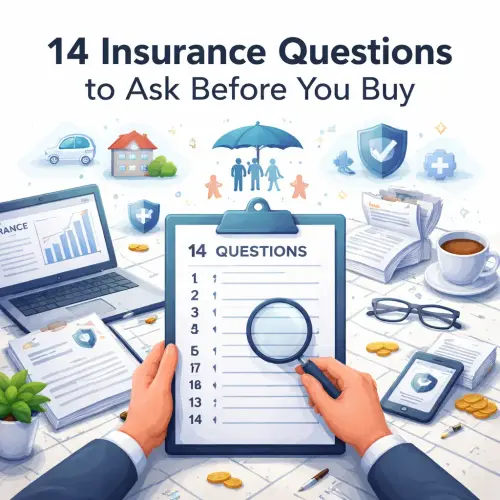
Why Asking These Insurance Questions Before You Buy Matters
Buying insurance is a significant financial decision, whether it’s for health, life, car, or home. Many first-time buyers and even experienced policyholders rush through the selection process and later discover gaps in coverage or surprising fees.
By preparing a list of Insurance Questions to Ask Before You Buy, you arm yourself with the knowledge to choose a plan that truly fits your needs. This approach helps you avoid common pitfalls like choosing a policy with a low premium but huge deductibles, or one that excludes the very situations you’re most concerned about.
Taking the time to ask these questions can save you thousands of pesos and provide genuine peace of mind. For a related guide, see 10 Insurance Mistakes That Cost Filipinos Thousands.
What Are the Most Important Insurance Questions to Ask Before You Buy?
To help you navigate the insurance landscape confidently, we’ve broken down the 14 essential questions every buyer should ask. These questions cover everything from basic coverage details to the fine print that often hides costly surprises.
1. What Are the Questions Help Compare Insurance Policies Effectively?
When you’re looking at multiple policies, it’s easy to get lost in the numbers. The best way to compare is to ask each provider the same set of standard questions. Start by asking for a summary of benefits and coverage that outlines what is included and excluded.
Compare the annual premium against the maximum out-of-pocket costs. Also, ask about the network of doctors or hospitals if it’s a health plan, and the list of covered events if it’s a life or property policy. This direct comparison helps you see which policy offers the best value, not just the lowest price.
Key Comparison Criteria
Always compare policies based on these five factors: premium cost, deductible amount, coverage limits, exclusions list, and claim settlement ratio of the insurer. Don’t just look at the monthly payment. A slightly higher premium might save you thousands in a claim. For a related guide, see 18 Insurance Facts Every Policyholder Should Know.
2. How Do I Know If an Insurance Policy Is Right for Me?
This question is about matching the policy to your personal circumstances. A policy is right for you if it covers your most significant risks without breaking your budget. Ask insurers to walk you through scenario-based examples. For instance, “If I am hospitalized for a week, what will my out-of-pocket expense be?” or “If I pass away unexpectedly, how much will my family receive and how quickly?” The right policy aligns with your financial goals, whether that’s debt protection for your family or covering medical bills for a chronic condition.
3. What Should I Know About Insurance Coverage Limits?
Coverage limits are the maximum amount an insurance company will pay for a covered loss. Many buyers make the mistake of choosing limits that are too low to save money. You need to ask: “What is the maximum benefit per incident?” and “Is there a lifetime maximum?” For health insurance, check per illness limits. For car insurance, ask about the limit for third-party property damage.
A policy with seemingly affordable premiums might have such low limits that it leaves you exposed to major financial loss. Always calculate how much coverage you realistically need based on your assets and potential risks.
4. What Are Important Questions About Insurance Exclusions?
Exclusions are the conditions or events the policy does not cover. This is one of the most critical areas to scrutinize. Ask the agent point-blank: “What are the top five things this policy does not cover that people often assume are covered?” Common health insurance exclusions include pre-existing conditions, dental care, and experimental treatments.
Life insurance often excludes deaths from certain high-risk activities or suicide within the first two years. Knowing the exclusions prevents devastating surprises when you try to file a claim. Request a written list of all exclusions before you sign anything. For a related guide, see 12 Types of Insurance Every Family Should Consider.
5. How Do Insurance Premiums Really Work?
Many people think premiums are just a fixed cost, but there’s more to it. Ask how the premium is calculated. Is it based on your age, health status, occupation, or a combination? Does it include any fees or taxes? For term life insurance, ask if the premium is level (stays the same) or increasing over time. For health insurance, ask if the premium changes as you age. Understanding how premiums work helps you budget for the long term and avoid policies that become unaffordable after a few years. Also, ask if there are discounts for annual payments or bundling policies.
6. What Should I Ask About Claim Processes?
The real test of an insurance policy is when you need to make a claim. Ask detailed questions about the claim process: “How do I file a claim?” “What documents are required?” “How long does the process usually take?” “Is there a 24/7 helpline?” Also ask about common reasons claims are denied for this specific policy. An insurer with a complicated or slow claim process can cause immense stress during an already difficult time. Look for insurers known for a high claim settlement ratio and a straightforward digital claim submission process.
7. How Can I Check If an Insurance Company Is Reliable?
Before you trust an insurance company with your financial future, research its stability and reputation. Ask for the company’s financial strength rating from agencies like A.M. Best, Standard and Poor’s, or local equivalents like the Philippine Insurance Commission (IC).
A strong rating indicates the company can pay claims even during economic downturns. Check online reviews and ask about the company’s claim settlement ratio, which is the percentage of claims paid versus received. A ratio above 90% is generally excellent. Also, look up if the company has any history of regulatory penalties or customer complaints.
8. What Questions Reveal Hidden Insurance Costs?
Hidden costs can turn a cheap-looking policy into an expensive one. Ask about the following: “Are there any administrative fees, processing fees, or policy fees?” “What is the surrender charge if I cancel early?” “Are there any co-payment requirements?” For investment-linked insurance, ask about fund management fees and sales loads.
Also, ask if the premium is subject to annual increases that aren’t obvious in the first year. A transparent insurer will eagerly provide a full breakdown of all possible charges. If an agent hesitates to answer, consider it a red flag.
9. How Do Waiting Periods Affect Insurance Coverage?
Waiting periods are the time you must wait after buying a policy before certain benefits kick in. This is very common in health and life insurance. Ask: “What is the waiting period for pre-existing conditions?” “Are there separate waiting periods for specific illnesses like cancer or heart surgery?” “When does coverage for accident-related injuries begin?” For maternity coverage, waiting periods can be 12 to 24 months. Understanding waiting periods is crucial for timing your purchase. If you expect to need a specific medical service soon, you need a policy with short or no waiting periods for that condition.
10. What Should I Ask About Policy Renewal Terms?
A policy isn’t a one-time purchase; you’ll need to renew it regularly. Ask about renewal terms: “Is the renewal guaranteed? Can the company refuse to renew me?” “How much will the premium increase at renewal age?” “What happens if I forget to pay the renewal premium – is there a grace period?” Some policies have built-in premium increases that make them unaffordable as you get older.
A policy with guaranteed renewability and predictable premium increases is safer for long-term planning. Understand the grace period, usually 30 to 60 days, and what happens if you miss the payment window entirely.
11. How Can I Make Sure I’m Not Overpaying for Insurance?
This is a common fear, especially for budget-conscious buyers. To avoid overpaying, ask for quotes from at least three different companies for the exact same coverage parameters. Ask the agent: “Are there any discounts available – for example, for being a non-smoker, having a safe driving record, or installing home security systems?” Also, ask if there are cheaper plan variants that still meet your minimum requirements.
Be cautious of agents who push for the most comprehensive (and expensive) package immediately without assessing your needs. A good agent will help you balance adequate protection with affordability.
12. What Details Should I Check in an Insurance Plan Before Signing?
Beyond the obvious coverage, check the fine print details. Ask about the following: “What is the exact definition of a ‘pre-existing condition’ in this policy?” “What is the definition of ‘accident’ – does it cover poisoning or sports injuries?” “Are there any geographical limits?” “What happens if I travel abroad?” Check the schedule of benefits carefully.
For example, a health plan may cover hospital room and board but only up to a specific daily limit that might be too low. Look at the policy document’s terms and conditions section for any clauses mentioned verbally that contradict the written text.
13. How Can I Avoid Mistakes When Choosing Insurance That Others Often Make?
Learning from others’ mistakes can save you from making them yourself. One frequent oversight is buying a policy that is too complex for your needs, like a bundled plan that adds riders you’ll never use. Another is relying solely on price without checking coverage details.
Ask your agent: “What is the most common reason people regret buying this specific policy?” “What do existing policyholders complain about most?” This can reveal issues like difficult claim processes or unexpected fee structures. Also, avoid making decisions under pressure – never buy on the same day you talk to an agent. Take at least 24 hours to review the policy document with fresh eyes.
14. Is There a Grace Period to Cancel If I Change My Mind?
In many countries, including the Philippines, insurance policies come with a free-look period, usually 15 to 30 days. This means you can cancel the policy within that timeframe and receive a full refund of the premium paid, minus minimal administrative charges. Ask: “What is the free-look period for this policy?” “Are there any penalties for canceling during this period?” “What is the process to cancel?” This safety net allows you to review the policy document at home and change your mind if you find it unsuitable. Always use this period to thoroughly read the policy and verify everything the agent promised.
Practical Steps: A Checklist for Comparison
To make comparing policies easier, use this simple checklist when speaking with each insurer.
| Feature to Check | Policy A | Policy B | Policy C |
|---|---|---|---|
| Annual Premium | ₱15,000 | ₱12,000 | ₱18,000 |
| Deductible per Year | ₱5,000 | ₱10,000 | ₱3,000 |
| Coverage Limit (Per Illness) | ₱1,000,000 | ₱500,000 | ₱2,000,000 |
| Waiting Period for Pre-existing | 6 months | 12 months | 24 months |
| Claim Settlement Ratio | 95% | 88% | 97% |
| Free-Look Period | 30 days | 15 days | 30 days |
Use this table to objectively score each option. Don’t just tick boxes – understand why one insurer charges a higher premium. It might be because they have a broader coverage network or a faster claim process.
Common Pitfalls to Avoid When Asking Your Insurance Questions
Even with the right questions, your buying journey can still go sideways. Avoid these common mistakes:
- Relying only on verbal promises. Always get everything in writing, especially exclusions and coverage limits. Oral promises are not binding.
- Not reading the policy document. The brochure is a summary; the policy document is the legal contract. Read it during the free-look period.
- Assuming all insurance agents are impartial. Many agents are tied to specific companies. Consider talking to an independent financial advisor who can recommend from multiple insurers.
- Choosing a policy based solely on monthly premium. A low premium might hide limited coverage or high out-of-pocket costs.
How to Tailor Your Questions for Different Types of Insurance
While the 14 questions above are universal, you should adjust your focus depending on the type of insurance you’re buying. Here is how to customize your Insurance Questions to Ask Before You Buy for common policy types.
Health Insurance Questions
Focus on network hospitals, outpatient coverage, and emergency care. Ask: “Which hospitals are in the direct pay network?” “Does the policy cover outpatient consultations and medicines?” “Is there coverage for critical illnesses as a rider?” Health insurance is the most complex, so spend extra time on exclusions and waiting periods.
Life Insurance Questions
Focus on the death benefit, premiums, and cash value (for whole life). Ask: “Is the death benefit guaranteed to not change?” “Can I increase or decrease coverage later?” “What happens if I stop paying premiums – is there a non-forfeiture option?”
Car Insurance Questions
Focus on deductibles, third-party liability, and Acts of God coverage. Ask: “What is the deductible for a own-damage claim?” “What is the limit for third-party property damage?” “Does this policy cover damage from floods, typhoons, and earthquakes?”
Property Insurance Questions
Focus on replacement cost vs. actual cash value, and specific perils covered. Ask: “Does this policy pay the replacement cost of my property or only the current market value?” “Which natural disasters are covered? Are floods, typhoons, and landslides listed explicitly?”
Useful Resources
To further verify an insurer’s reliability, use these resources to check financial strength and complaint records. The Insurance Commission of the Philippines provides official data on registered companies and their compliance. For comparative research, websites like Moneymax offer policy comparisons and reviews from Filipino consumers.
Frequently Asked Questions About Insurance Questions to Ask Before You Buy
What is the most important question to ask before buying insurance?
Start by asking “What exactly does this policy cover and what does it not cover?” This helps you understand the core benefits and avoid nasty surprises later.
Should I buy insurance solely based on the cheapest premium?
No. A low premium often comes with high deductibles, limited coverage, or strict exclusions. Focus on the overall value, which includes coverage limits, network accessibility, and claim ease.
How can I avoid hidden fees in an insurance policy?
Ask directly about “Administrative fees, processing fees, surrender charges, and fund management fees.” Also request a full fee schedule in writing before you sign.
What is the free-look period in insurance?
The free-look period is a grace period, usually 15 to 30 days, during which you can cancel the policy for a full refund if you change your mind.
How do waiting periods affect my coverage?
A waiting period is the time you must wait after buying the policy before certain benefits, especially for pre-existing conditions, become payable.
What is the claim settlement ratio and why does it matter?
This ratio shows the percentage of claims an insurer has paid. A ratio above 90% indicates a company that pays most of its claims, making it more reliable.
Can I compare insurance policies from different companies?
Yes. Ask each provider for a standardized summary of benefits and costs. Use a comparison table like the one in this article to compare side by side.
What should I check about policy renewal terms?
Ask if the policy is guaranteed renewable, how premium increases are calculated at renewal, and what the grace period is if you miss a payment.
How can I tell if an insurance company is reliable?
Check its financial strength rating from agencies like A.M. Best, look up its claim settlement ratio, and read customer reviews on independent websites.
What questions help compare health insurance policies?
Ask about hospital network, coverage for outpatient services, pre-existing condition exclusions, waiting periods, and annual coverage limits.
How do insurance exclusions work?
Exclusions are specific conditions, events, or circumstances that your policy does not cover. Examples include war, pre-existing conditions, or self-inflicted injuries.
What questions reveal hidden insurance costs ?
Ask about policy fees, cancellation charges, contract alteration fees, and whether the premium is subject to annual increases.
What is a deductible in insurance?
A deductible is the amount you pay out-of-pocket before your insurance starts to pay for a covered loss. Higher deductibles usually mean lower premiums.
How do I ensure I am not overpaying for insurance?
Get at least three quotes for the same coverage, ask for all available discounts, and compare the total cost of the policy over a few years, not just the first year’s premium.
What information should I have ready when speaking to an insurance agent?
Prepare your age, medical history, current coverage, financial obligations (mortgage, dependents), and your primary reason for buying insurance.
Is it better to buy insurance online or through an agent?
Online can be faster for simple policies, but an agent can help you customize a plan and explain complex terms. For first-time buyers, speaking to a licensed agent is often recommended.
What are the common mistakes first-time insurance buyers make?
Common mistakes include buying too much coverage, choosing a policy based only on price, ignoring exclusions, and not reading the policy document thoroughly.
How often should I review my insurance policy?
Review your policy at least once a year or after any major life event like marriage, having a child, buying a house, or changing jobs.
Can I switch insurance policies if I find a better one?
Yes, but be aware of surrender charges on the old policy and waiting periods for pre-existing conditions on the new one. Compare carefully before switching.
What should I do if an insurance agent pressures me to buy immediately?
Walk away. A trustworthy agent gives you time to review the policy. Never make a purchase on the same day you first discuss it.